Bring
the idea.
Making a game used to take a studio. More and more, a small team will do, or even one person with good tools and a strong idea. That shift is what we are building Game Factory around.
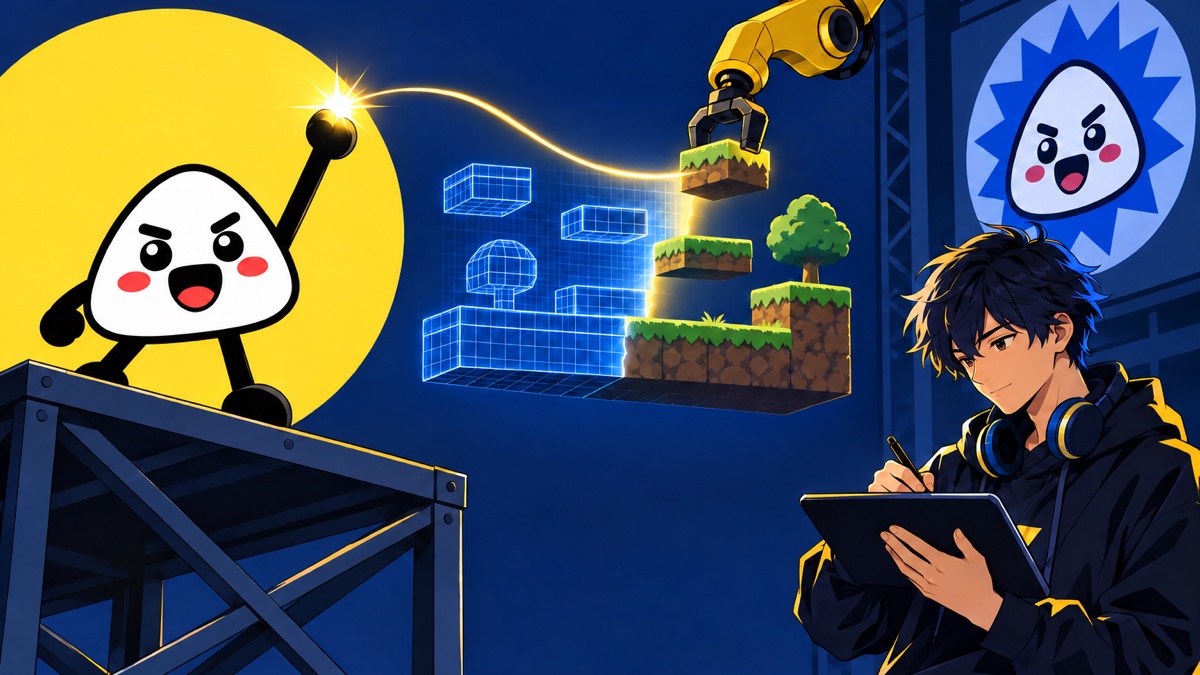
AI matters here, though not because it can make good games on its own.
It speeds up code, helps with art and prototypes, finds bugs and takes the grind. It cannot say why a game should exist, give it humour and character, or tell why one mechanic pulls you in and another annoys you. For us AI is a tool that leaves more time for the creative part, and no substitute for it.
Where the market is going
You can already see it. The 2025 Vibe Jam drew more than a thousand games, even though the rules required at least 80% of each game to be made with AI. In 2026 the bar rose to 90% of the code, and 945 games came in. That says nothing about quality. It shows how fast the road from idea to prototype has shrunk.
VIBE JAM 2026, FROM ITS ORGANISERIn July 2026 Roblox showed Build, which turns a text description into a simple game. By September about nine thousand games had been published with it, and 71% of its users had never opened Roblox Studio. New tools bring in people who until recently did not think of themselves as developers.
ROBLOX ON BUILDOn Steam, the share of new games whose developers disclosed generative AI went from 10.9% in 2024 to 19.9% in 2025 and 30.8% in the first half of 2026, in a count of nearly fifty-four thousand releases. A disclosure does not mean AI made a third of the game. It does mean AI is ordinary production now.
THE STEAM COUNT, SUMMARISEDThe industry is far from thrilled. In GDC’s 2026 survey, 36% of professionals use generative AI and 52% call its effect negative. The tool is useful enough to spread fast and troubling enough that nobody takes it for the answer to everything.
GDC STATE OF THE GAME INDUSTRY 2026We see it the same way. Making games got cheaper. Imagination did not, and neither did taste, or the patience to rework a mechanic for months until it works. Ideas used to die because nobody could build them. More and more, it will be the other way round.
You can build the game now. You still have to give someone a reason to play it.
What Game Factory is
Game Factory is not a generator where one prompt gives you a finished game; we do not think interesting games are made that way. It is a production space around the author: tools, know-how, automatic checks and ready parts for the work that takes time and does not make a game unique.
We started with our own game. Making GOHAN means solving concrete problems: keeping a character identical across every animation, checking automatically that a level can be finished, catching breakage before a player does, teaching an agent the game’s architecture so it can carry a long piece of work. A solution that holds up outlives the project as a tool, a template, a skill for an agent or a write-up.
That is the factory: a problem solved once does not have to be solved again by every author after us. The more of it we lift out of the creative part, the more attention is left for what makes one game different from another.
The first game as proof
So the GOHAN platformer is not the end goal. It is the first testing ground, built the way we want others to build: AI helps with code, assets and routine, automatic checks cover the levels, the agent keeps gaining context. The decisions stay human: who the hero is, what makes him funny, where a level is dull or annoying, and what to cut even after two days went into it.
One can talk about a platform for a long time. Shipping a game and showing the tools that came out of it is more convincing. If they only help us, that is not a factory yet. If the next person saves weeks with them, the idea works.
From player to author
New tools shorten another distance too: the one between player and author. Today someone plays a level. Tomorrow they change it in the editor, then make their own, and one day build a small game from a familiar mechanic and ready tools. That used to require becoming a developer first. We want the road to be shorter.
Not every player will become a developer, and that is fine. But almost everyone has said “it would be cool to make a game where…” and stopped there. That is the distance we want to close. Hence level editors, constructors, jams and idea contests. And nobody has to do it all alone: the idea can be one person’s, the mechanic another’s, the characters a third’s, the sound a fourth’s.
Why GOHAN is here
GOHAN is not Game Factory itself, and not a technology the games need in order to run. We do not want a product where you must understand a token, make a wallet and perform crypto rituals before you see a game.
For us GOHAN is how we attract people and build a community. A meme gives a project what a tech platform earns much harder: a recognisable character, its own language, and people who want to take part. Through GOHAN we bring players to the games and run idea and level contests, jams and tournaments. Someone meets GOHAN as a meme, then plays, tries the editor or pitches an idea, and the line between audience and creators starts to blur. That is what interests us most.
The token itself must never get in the way. If a mechanic works better without a blockchain, it will work without one. Crypto belongs where it adds something: transparency, digital ownership, open community mechanics, an economy between participants. Never just so the product can be called crypto.
Beyond crypto
That is why traditional finance matters so much to us. The crypto market can give us a first community, but it is too small to be the only place we grow. If we want ordinary players and independent authors, the platform has to feel as familiar as any game service. A bridge to the traditional financial system is, for us, the road to a wider audience, and no retreat from crypto.
We are not interested in one more closed crypto economy where money circles between the same people. Real growth starts when the product interests someone from outside. Game Factory has to compete for attention with ordinary games and services, and not only with other blockchain projects.
In what order
We start with the simplest and the hardest thing: our own game. It has to be finished and good on its own, and whatever we make for it that can be general becomes a tool. Then a space for developers. Then editors and constructors for people without a development background. Then contests, jams and the first community projects. Only when there are real authors and real games does a full home for them make sense.
We are not starting with the promise of a big platform. Each layer comes when the one before it works. The game produces tools. Tools let others make games. Games bring players. Players and authors become a community. GOHAN helps gather and keep it, and the traditional economy lets it grow far beyond the crypto market.
If it works, Game Factory will not be a place that “makes games with AI”. It will be a place where technology clears the technical obstacles between a person and their idea, and leaves the idea with them.
In the end the question is a human one: what game do you want to make?
Bring the idea. The rest should get easier.